In the light of the recent events surrounding PM Lee's lawsuit threat against TR Emeritus, I would like to issue a challenge to the Prime Minister, the Minister of Finance and the Board of Directors of Temasek Holdings, to put to rest, once and for all, the doubts and rumours surrounding Ho Ching's appointment as CEO of Temasek Holdings.
Instead of wasting time and money on unleashing lawsuit threats against hapless bloggers, the Prime Minister and the Government of Singapore should practice the highest standards of transparency and accountability with regards to the corporate governance of Temasek Holdings, for the benefit of its ultimate beneficiary owners, the citizens of Singapore.
I demand that the Prime Minister provide complete, incontrovertible, exhaustive documentary evidence demonstrating beyond a shadow of doubt that the selection process that ended in the appointment of Ho Ching as CEO of Temasek was made "on merit and through proper process".
Showing posts with label Temasek Holdings. Show all posts
Showing posts with label Temasek Holdings. Show all posts
Tuesday, February 21, 2012


Sunday, September 04, 2011
Wikileaks' Stunning Revelations about Singapore's Corporate Elite
Something that particularly piqued my interest today was the profound Wikileaks revelations about the Island Power saga, and Singapore's corporate sector in general.
Island Power is an 800MW independent power producer (IPP) gas-fired power plant in Singapore that recently (mid 2011) achieved financial close and commencement of construction. It competes with the three large Gencos, Senoko Power, PowerSeraya and Tuas Power that were formerly owned by Temasek Holdings and that were privatised to foreign investors in 2007-2008. Island Power also competes with two GLCs in the Singapore power sector, namely Keppel Merlimau Cogen (Keppel Corp) and Sembcogen (Sembcorp Utilities).
The development of Island Power has taken a very long time, and goes as far back as 2000, when the original sponsor of the project, Intergen, got a license from the Energy Market Authority (EMA) and started the process to develop the power plant in Singapore. However, for more than 10 years, Island Power was beset with delays, ostensibly regarding their ability to procure access to a natural gas pipeline supply from Indonesia and other reasons. Wikileaks, however, has revealed more or less everything surrounding the delay (and subsequent abandonment) of Island Power in the hands of Intergen:
"For about six years Singapore Temasek and its subsidiaries have deliberately and successfully blocked efforts by Intergen and local subsidiary Island Power to access an offshore gas pipeline between Indonesia and Singapore. While the GOS was taking public steps to encourage competition and liberalize its gas market, Temasek was working hard to block potential competitors (ref D), claimed Michael Reading (protect), Managing Director of Island Power. Reading said that Temasek at various points threatened personal defamation lawsuits, claimed it "controlled the government," and pledged to "frustrate" Island's efforts to operate in Singapore."
Tuesday, August 11, 2009
The Temasek Problem is Not a Temasek Problem (Why Tharman Shanmugaratnam is Ho Ching's Best Friend)
The major news headline to hit the press in July was the failure of the announced leadership transition by Temasek Holdings to materialise. Back in February, Ho Ching announced her resignation and that she would hand over power of Singapore's Sovereign Wealth Fund to Charles Goodyear. At that time, the Merrill-BoA merger was being finalised and the BoA share price was hitting record lows. Here's a snapshot, if you don't remember.
At the time, the announcement was very surprising indeed, to observers who had been used to criticising the fact that Mdm Ho Ching was the Prime Minister's wife, as well as Lee Kuan Yew's daughter-in-law. That the top corporate job in Singapore was held by yet another member of the Lee family was, in the eyes of many observers, evidence of cronyism and nepotism in the Lee regime.
Many speculated over the reason for the sudden announcement of the stepping down of Ho Ching to give way to Charles Goodyear. Perhaps it was because of the massive losses that Temasek had sustained due to its over-allocation of resources to the financial sector. Perhaps it was because Ho Ching couldn't take the criticisms of having ascended to the CEO position because of her connections. Whatever the case, it seemed that Temasek was taking a significant step towards its image as a genuinely independent entity - by putting a foreigner in charge.
Fast forward five months, and Chip goodyear is leaving Temasek before even spending a single day as CEO. He is leaving amicably, due to 'strategic differences' - so goes the official line.
Of course, every Singaporean is left scratching his/her head trying to figure what is going wrong with the Temasek leadership transition. According to sources,
Of course not - and that's because the Government bears ultimate responsibility for Temasek's stuff ups. Ultimately, the Government must bear the consequences of any mismanagement of reserves. Likewise, it will take credit for any 'good' news where Temasek is concerned. The Government has a vested interested in keeping information about Temasek cock-ups hidden away from public consumption.
Thus, can Temasek ever be expected to suddenly become transparent and candid about its management stuff ups and its investment errors? No, it will only be transparent to the extent that its shareholder demands it, and to the extent that regulations require. Since Temasek is not a publicly listed company, Singaporeans cannot expect Temasek to be transparent on the basis that its publicly listed subsidiaries are. And since Government ministers repeatedly say that it is not their role to comment on individual investments - Temasek will never come clean on individual investment decisions, nor will the truth ever be told about why Chip Goodyear quit.
No - what Singaporeans expect from Temasek - they first have to demand of the Government. If Singaporeans want transparency and accountability about Temasek's investments and policy decisions, they have to first demand transparency and accountability from the Singapore Government. If Singaporeans want information about Temasek's decision making process, they have to demand the same sort of information from the Singapore Government. They have to demand that Tharman Shanmugaratnam keep a close watch on the major individual decisions that Temasek makes - and in turn - either report this information to the Singapore people, or require that Temasek makes the appropriate disclosures. It is only after we establish a culture of tranparency and accountability at the highest echelons of Singapore's society, that the lieutenants & the troops will then follow in line.
Indeed, the Temasek Problem is Not a Temasek Problem; The Temasek Problem is a Government of Singapore problem. Ultimately, the quality of corporate governance of Temasek Holdings will mirror the quality of political governance of the Government of Singapore.
And until Singaporeans realise this, they will have to continue living with the opacity and secrecy that shrouds Temasek Holdings - protected as it is by its political masters.
At the time, the announcement was very surprising indeed, to observers who had been used to criticising the fact that Mdm Ho Ching was the Prime Minister's wife, as well as Lee Kuan Yew's daughter-in-law. That the top corporate job in Singapore was held by yet another member of the Lee family was, in the eyes of many observers, evidence of cronyism and nepotism in the Lee regime.
Many speculated over the reason for the sudden announcement of the stepping down of Ho Ching to give way to Charles Goodyear. Perhaps it was because of the massive losses that Temasek had sustained due to its over-allocation of resources to the financial sector. Perhaps it was because Ho Ching couldn't take the criticisms of having ascended to the CEO position because of her connections. Whatever the case, it seemed that Temasek was taking a significant step towards its image as a genuinely independent entity - by putting a foreigner in charge.
Fast forward five months, and Chip goodyear is leaving Temasek before even spending a single day as CEO. He is leaving amicably, due to 'strategic differences' - so goes the official line.
Of course, every Singaporean is left scratching his/her head trying to figure what is going wrong with the Temasek leadership transition. According to sources,
"A person familiar with the situation said last week that Mr. Goodyear's proposals for the company's new strategic direction were considered too risky by some, without elaborating. He also said Mr. Goodyear planned changes in senior management that weren't well received by Temasek's board."But what are the real reasons? Singaporeans will never know... because Tharman Shanmugaratnam is Ho Ching's best friend.
But of course. Did any of us really expect Mr Shanmugaratnam to reveal anything that we do not already know? Did any of us really expect to find out anything truly and genuinely useful about Temasek through the parliamentary proceedings?Aug 18, 2009
S'pore Parliament
No goodwill for Goodyear
By Robin ChanFORMER chief executive-to-be Mr Charles Goodyear received no goodwill payment for his four months' work at Temasek Holdings the Finance Minister revealed in Parliament.
But after 25 minutes of grilling, the House emerged none the wiser over what exactly the strategic differences were that led to his sudden departure.
Members of Parliament threw question after question at Mr Tharman Shanmugaratnam asking him to get Temasek to share with the public what went on behind the scenes but he would not budge.
He said that disclosing the information would serve no strategic purpose and that was not unlike the actions of other publicly-listed companies in the private sector.
'People do want to know, there is curiosity, it is a matter of public interest. That is not sufficient reason to disclose information. It is not sufficient that there be curiosity and interest that you want to disclose information,' he said in response to questioning from Mr Low Thia Khiang, opposition MP for Hougang.
He reiterated that the words in Temasek's statement to the public were carefully chosen and the Government would not add to that.
Of course not - and that's because the Government bears ultimate responsibility for Temasek's stuff ups. Ultimately, the Government must bear the consequences of any mismanagement of reserves. Likewise, it will take credit for any 'good' news where Temasek is concerned. The Government has a vested interested in keeping information about Temasek cock-ups hidden away from public consumption.
Thus, can Temasek ever be expected to suddenly become transparent and candid about its management stuff ups and its investment errors? No, it will only be transparent to the extent that its shareholder demands it, and to the extent that regulations require. Since Temasek is not a publicly listed company, Singaporeans cannot expect Temasek to be transparent on the basis that its publicly listed subsidiaries are. And since Government ministers repeatedly say that it is not their role to comment on individual investments - Temasek will never come clean on individual investment decisions, nor will the truth ever be told about why Chip Goodyear quit.
No - what Singaporeans expect from Temasek - they first have to demand of the Government. If Singaporeans want transparency and accountability about Temasek's investments and policy decisions, they have to first demand transparency and accountability from the Singapore Government. If Singaporeans want information about Temasek's decision making process, they have to demand the same sort of information from the Singapore Government. They have to demand that Tharman Shanmugaratnam keep a close watch on the major individual decisions that Temasek makes - and in turn - either report this information to the Singapore people, or require that Temasek makes the appropriate disclosures. It is only after we establish a culture of tranparency and accountability at the highest echelons of Singapore's society, that the lieutenants & the troops will then follow in line.
Indeed, the Temasek Problem is Not a Temasek Problem; The Temasek Problem is a Government of Singapore problem. Ultimately, the quality of corporate governance of Temasek Holdings will mirror the quality of political governance of the Government of Singapore.
And until Singaporeans realise this, they will have to continue living with the opacity and secrecy that shrouds Temasek Holdings - protected as it is by its political masters.
Friday, May 22, 2009
Wiffle Waffle, Gobbledygook, Smokescreens and Nonsense!!!
Warning: This post contains several expletives. Readers who are offended by strong language are advised to proceed cautiously.
Myrna Thomas of Temasek has written to the press to "explain" the BoA divestment. Her press statement not only does not clarify anything, it only insults the intelligence of Singaporeans by repeating the same truisms and smokescreens that Temasek has been saying time and time again.
What the F*cK does this have to do with the BoA issue? You donks have been repeating this nonsense year in year out ad nauseum - it does not give us any information at all, it does not tell us anything - its completely useless statements that achieves nothing!!!
Myrna Thomas of Temasek has written to the press to "explain" the BoA divestment. Her press statement not only does not clarify anything, it only insults the intelligence of Singaporeans by repeating the same truisms and smokescreens that Temasek has been saying time and time again.
Why Temasek sold its stake in BoA
I REFER to recent reports and commentaries on Temasek's divestment of its Bank of America (BoA) stake. We would like to clarify some of the points raised.
Temasek invests with the objective of delivering sustainable returns over the long term. This means our investment strategy is not aimed at delivering target returns on a year-by-year basis. This is why we report our portfolio returns not just for a single year, but for various time horizons in our annual Temasek Review.
What the F*cK does this have to do with the BoA issue? You donks have been repeating this nonsense year in year out ad nauseum - it does not give us any information at all, it does not tell us anything - its completely useless statements that achieves nothing!!!
Wednesday, May 20, 2009
This is Becoming Hilarious - and Shameful!!
Forget about Investing for the "Long Term" - Temasek's new investment strategy has changed into "Buy High, Sell Low!!!"
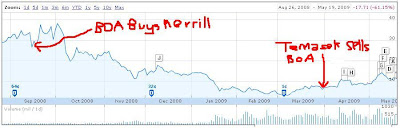
What else could you possibly deduce from the fact that Bank of America's shares have surged 74% since our dear Ho Ching & company decided to divest of their BoA shares? This fact has been graciously pointed out to us by the New York Times - article appended below.

The world is watching our dear Singaporean SWF. And Temasek is becoming the laughing stock of the world financial community.
A commenter on the NYT blog has said:
Earlier, David Faber of CNBC noted that Temasek's loss was one of the biggest losses ever recorded by a single fund on a single investment in Wall Street's history.
I'm not sure I want to be a Singaporean anymore.
---------------------------------------------------------------------
New York Times - Dealbook
MAY 18, 2009, 11:13 AM
Wall Street Warms Up to Bank of America
Kenneth D. Lewis may have gotten a rebuke from shareholders last month, but he was getting votes of confidence from Wall Street on Monday. Upbeat assessments from analysts at Citigroup and Goldman Sachs lit a fire under shares of Bank of America, the banking giant where he is chief executive — and was chairman until a few weeks ago, when shareholders voted to remove him from that latter post.
At first glance, the enthusiasm might seem to come at a strange time. Banking regulators just told BofA to raise nearly $34 billion, suggesting it was the most anemic of the 19 financial institutions that endured the government’s stress tests.
But some analysts think Bank of America’s efforts to raise the capital are proceeding well. If that overhang clears up, it could ease the pressure that has been weighing on the company’s stock price.
Analysts at Goldman raised BofA from neutral to buy and added the company to their so-called conviction list of recommended stocks. Analysts at Citigroup kept a buy rating on the shares, but had positive things to say about the integration of BofA and Countrywide, the troubled mortgage lender it recently bought, as well as its capital-raising plans.
BofA is using “at-the-market” stock sales to raise a large part of its additional capital cushion. That means the shares are quietly dribbling out in unknown quantities. Reading the tea leaves — and watching the volume of BofA stock trades — analysts at Citi, led by Keith Horowitz, estimate it has already raised $3 billion to $4 billion from selling new stock.
In addition, Bank of America raised an estimate $4 billion after taxes from the recent sale of part of its stake in China Construction Bank.
The biggest unknown appears to lie in BofA’s plan to convert about $16 billion in institutionally held preferred stock into common. If BofA can offer a price that is above the equivalent price of the common shares, it will minimize the dilution for current shareholders, the analysts said.
The analysts’ comments may be gratifying to Mr. Lewis, who endured some heated attacks at last month’s meeting from shareholders who lost money.
But Temasek, the investment arm of Singapore, could be feeling a bit of seller’s remorse. The fund recently reported selling its entire stake in BofA — at an enormous loss, by all accounts — some time before March 31. Since then, BofA’s stock is up about 74 percent.
What else could you possibly deduce from the fact that Bank of America's shares have surged 74% since our dear Ho Ching & company decided to divest of their BoA shares? This fact has been graciously pointed out to us by the New York Times - article appended below.

The world is watching our dear Singaporean SWF. And Temasek is becoming the laughing stock of the world financial community.
A commenter on the NYT blog has said:
Regarding Temasek’s decision to sell BofA shares near the low - perhaps sovereign wealth fund managers are really just government bureaucrats masquerading as fund managers? If anyone is going to take a loss on an investment - I’m glad it’s them.
— Posted by Jay Young
Earlier, David Faber of CNBC noted that Temasek's loss was one of the biggest losses ever recorded by a single fund on a single investment in Wall Street's history.
I'm not sure I want to be a Singaporean anymore.
---------------------------------------------------------------------
New York Times - Dealbook
MAY 18, 2009, 11:13 AM
Wall Street Warms Up to Bank of America
Kenneth D. Lewis may have gotten a rebuke from shareholders last month, but he was getting votes of confidence from Wall Street on Monday. Upbeat assessments from analysts at Citigroup and Goldman Sachs lit a fire under shares of Bank of America, the banking giant where he is chief executive — and was chairman until a few weeks ago, when shareholders voted to remove him from that latter post.
At first glance, the enthusiasm might seem to come at a strange time. Banking regulators just told BofA to raise nearly $34 billion, suggesting it was the most anemic of the 19 financial institutions that endured the government’s stress tests.
But some analysts think Bank of America’s efforts to raise the capital are proceeding well. If that overhang clears up, it could ease the pressure that has been weighing on the company’s stock price.
Analysts at Goldman raised BofA from neutral to buy and added the company to their so-called conviction list of recommended stocks. Analysts at Citigroup kept a buy rating on the shares, but had positive things to say about the integration of BofA and Countrywide, the troubled mortgage lender it recently bought, as well as its capital-raising plans.
BofA is using “at-the-market” stock sales to raise a large part of its additional capital cushion. That means the shares are quietly dribbling out in unknown quantities. Reading the tea leaves — and watching the volume of BofA stock trades — analysts at Citi, led by Keith Horowitz, estimate it has already raised $3 billion to $4 billion from selling new stock.
In addition, Bank of America raised an estimate $4 billion after taxes from the recent sale of part of its stake in China Construction Bank.
The biggest unknown appears to lie in BofA’s plan to convert about $16 billion in institutionally held preferred stock into common. If BofA can offer a price that is above the equivalent price of the common shares, it will minimize the dilution for current shareholders, the analysts said.
The analysts’ comments may be gratifying to Mr. Lewis, who endured some heated attacks at last month’s meeting from shareholders who lost money.
But Temasek, the investment arm of Singapore, could be feeling a bit of seller’s remorse. The fund recently reported selling its entire stake in BofA — at an enormous loss, by all accounts — some time before March 31. Since then, BofA’s stock is up about 74 percent.
Monday, May 18, 2009
Temasek’s divestment of BoA stake – A clear admission of an investment error
"Yes, they were good long term investments with risks thoroughly assessed"
- Minister Tharman, Jan 2008 on Singapore investments in banks.
These were the words of Singapore's Minister of Finance, slightly more than a year ago when Singapore's SWFs made major investments in a few global financial institutions. Take note, in particular, that Minister Tharman was defending the individual investments made by the SWFs in the banks - not the portfolio performance.
A year later, everything had changed. The stock markets had declined significantly and the global financial system was in major turmoil. The stock prices of the big banks had sunk to record lows after having their balance sheets destroyed by the dislocation in credit markets. Seeing that his original argument was no longer tenable, Tharman changed his tack as the investments in the banks sunk deeper and deeper into the red. Now, instead of taking the line that the investments in the banks were good long term investments, he instead argued that Singapore's portfolios were well diversified, and hence Singapore's investments were fine.
'We would be worried if global banks comprise a large proportion of the portfolios of GIC and Temasek, or for that matter, any other highly vulnerable industry globally,' he said. 'But these are diversified portfolios, with not a large degree of concentration risk.'
- Minister Tharman, Jan 2009, on Singapore investments in banks.
Thursday, February 19, 2009
"Substantial Long-term Returns" From Bank Investments? Fat Hope, GIC
Well well, things are getting exciting. All of us know that GIC is reported to have incurred losses of US$33 Billion. All of us know that the government keeps on saying that GIC & Temasek are long term investors. And guess what, the press reported that GIC expects long-term returns from its bank investments (and I think, that's what Temasek expects as well)
Singapore’s GIC Loses $33 Billion as Assets Tumble, WSJ Says
By Andrea Tan and Chris Peterson
Feb. 17 (Bloomberg) -- Government of Singapore Investment Corp., one of two sovereign wealth funds owned by the island, lost as much as S$50 billion ($33 billion) in 2008, the Wall Street Journal said, citing two people familiar with the matter.
The fund doesn’t plan to get rid of its investments including in Citigroup Inc. and UBS AG even as asset values plummet, the newspaper said. GIC expects the two banks to provide substantial long-term returns, according to the report.
Sovereign wealth funds in Asia and the Middle East have pumped money into global financial institutions to help replenish capital eroded by writedowns and losses that have topped $1 trillion globally. GIC, overseeing more than $100 billion of reserves, has invested about $18 billion in UBS and Citigroup since December 2007.
Thursday, February 12, 2009
Temasek's Performance - A Dismal Failure of Singapore's Elitism
Government officials and Temasek executives have repeatedly held the line that Temasek's portfolio performance should be evaluated, not simply the performance of individual investments. It is thus no surprise that Temasek's latest unveiling of its recent portfolio performance has come under intense scrutiny, not just by Singaporeans, but by financial analysts all over the world.
This morning, the press reported a 31% drop in the market value of Temasek's portfolio from March 08 to Nov 08. Under rigorous enquiry about the performance of Temasek, government officials retorted that Temasek's performance has been 'respectable' compared to the performance of global investment indices, such as that of the MSCI world index.
Indeed, Temasek may have a case that its performance, relative to world indices, is respectable. The MSCI world index has crashed a whopping 40% since March 08. However, it is extremely unfortunate that Temasek, which prides itself on offering scholarships to Singapore's 'best and brightest', and hiring top foreign talent, is benchmarking its performance to the average performance of the rest of the world. Temasek's only defence is that it is 'above average.'
Temasek's executives and Singapore's politicians, instead, should be benchmarking Temasek's performance to the best and brightest in the world. If indeed Temasek has top talent, its performance should be comparable to the top fund managers. But the truth is, Temasek is no where near the top. In comparison to the best performers, its performance is a dismal failure.
In late 2007, Bloomberg made the following report:
Indeed, Temasek cannot say that "no one saw it coming." John Paulson and others did - they saw the excessive leverage, lax lending standards, and mispricing of credit risk in the markets - and took bets against the credit markets that paid off handsomely.
The following statement was by hedge fund manager John Paulson, in his statement to the US House of Representatives in November 2008:
The best and the brightest brains saw the credit crunch coming, and Temasek did not. Indeed, not only did Temasek not see the crunch coming, it went long the credit markets in 2008 - by making massive bets on financials like Merrill Lynch and Barclays. As a result, it made massive losses as the banks further imploded.
Well, even if Temasek didn't short the credit markets, it could have at least avoided making the stupid investments in the investment banks, just as Warren Buffett sat on the sidelines. But instead of just doing nothing, Ho Ching and company just had to get their hands itchy.
Meanwhile, the best and the brightest continued to do what they did best - and make money. To add on to the $1b+ in fees he earned in 2007, John Paulson continued his winning streak in 2008, by continuing to bet against the credit markets and financial institutions - bets that were directly opposite to Temasek's:
Temasek really has no excuse. It pays millions in compensation to its management every year. It is supposed to be staffed by the smartest investment minds out there. But its performance during this credit crisis has been, quite simply, mediocre. If we compare the 2008 31% loss in Temasek's portfolio to Paulson's whopping 37.6% gain - thats a net difference of 68.6%. Temasek has underperformed what should be its benchmark by a whopping margin!
Indeed, what we have isn't a bunch of particularly smart people at Temasek - what we have is a bunch of people suffering the curse of group think, of people mindlessly following the advice of their stock analysts - unable to truly see what is happening. What has happened with Temasek's investments should make clear to Singaporeans that there is really no such thing as the "elite" as defined by Singapore's "top brass" - they're just ordinary, mediocre investors - like you and me.
And the sooner Singaporeans realise that, the better. If we did, we would have had a decent chance of avoiding the disastrous capital destroying investments in Shin Corp, Merrill, Barclays and ABC learning. And we'd be billions of dollars more well off as a nation, than we are today.
This morning, the press reported a 31% drop in the market value of Temasek's portfolio from March 08 to Nov 08. Under rigorous enquiry about the performance of Temasek, government officials retorted that Temasek's performance has been 'respectable' compared to the performance of global investment indices, such as that of the MSCI world index.
Indeed, Temasek may have a case that its performance, relative to world indices, is respectable. The MSCI world index has crashed a whopping 40% since March 08. However, it is extremely unfortunate that Temasek, which prides itself on offering scholarships to Singapore's 'best and brightest', and hiring top foreign talent, is benchmarking its performance to the average performance of the rest of the world. Temasek's only defence is that it is 'above average.'
Temasek's executives and Singapore's politicians, instead, should be benchmarking Temasek's performance to the best and brightest in the world. If indeed Temasek has top talent, its performance should be comparable to the top fund managers. But the truth is, Temasek is no where near the top. In comparison to the best performers, its performance is a dismal failure.
In late 2007, Bloomberg made the following report:
Paulson Housing Bets Make $2.7 Billion
By Anthony Effinger
Nov. 29, 2007 (Bloomberg) -- The subprime crisis that's caused so much trauma for hedge funds and investment banks has brought only good news for John Paulson. He's the manager of more than $7 billion in hedge fund money keyed to mortgage credit.
Paulson started warning his investors back in the middle of 2006 that the frenzy to build and sell housing was a bubble about to pop. His New York-based firm, Paulson & Co., made big bets predicting the edifice would soon come crashing down. The wager paid off in the first nine months of 2007, when Paulson's Credit Opportunities funds rose an average of 340 percent.
That gain earned Paulson an estimated $1.14 billion in performance fees for the nine months ended on Sept. 28. Fees on Paulson's other eight funds bring his total to $2.69 billion, which puts Paulson and co-manager Paolo Pellegrini at the top of Bloomberg's ranking of best-paid hedge fund managers. John Paulson is no relation to Treasury Secretary Henry Paulson, the former chief executive officer of Goldman Sachs Group Inc.
Next on the list is Philip Falcone, whose New York-based Harbinger Capital Partners also bet against the housing boom and collected incentive payouts of $1.3 billion for the same nine months. In third place was Jim Simons, president of Renaissance Technologies LLC in East Setauket, New York.
Indeed, Temasek cannot say that "no one saw it coming." John Paulson and others did - they saw the excessive leverage, lax lending standards, and mispricing of credit risk in the markets - and took bets against the credit markets that paid off handsomely.
The following statement was by hedge fund manager John Paulson, in his statement to the US House of Representatives in November 2008:
"In 2005, our firm became very concerned about weak credit underwriting standards, excessive leverage among financial institutions and a fundamental mis-pricing of credit risk. To protect our investors against the risk in the financial markets, we purchased protection through credit default swaps on debt securities we thought would decline in value due to weak credit underwriting. As credit spreads widened and the value of these securities fell, we realized substantial gains for our investors."
The best and the brightest brains saw the credit crunch coming, and Temasek did not. Indeed, not only did Temasek not see the crunch coming, it went long the credit markets in 2008 - by making massive bets on financials like Merrill Lynch and Barclays. As a result, it made massive losses as the banks further imploded.
Well, even if Temasek didn't short the credit markets, it could have at least avoided making the stupid investments in the investment banks, just as Warren Buffett sat on the sidelines. But instead of just doing nothing, Ho Ching and company just had to get their hands itchy.
Meanwhile, the best and the brightest continued to do what they did best - and make money. To add on to the $1b+ in fees he earned in 2007, John Paulson continued his winning streak in 2008, by continuing to bet against the credit markets and financial institutions - bets that were directly opposite to Temasek's:
John Paulson’s Funds Shine in the Gloom
While his counterparts at other big hedge funds are trying to figure out whether they can stay in business, the fund manager John Paulson continues to rack up enormous profits. DealBook has obtained Mr. Paulson’s confidential year-end letter to his undoubtedly gleeful investors.
The 20-page report details how Mr. Paulson’s firm, Paulson & Company, which manages nearly $29 billion in assets, avoided the huge losses plaguing other funds, and it gives his firm’s outlook for this year.
Paulson Advantage Plus, the firm’s largest fund with roughly $7 billion in assets, returned a whopping 37.6 percent net of fees for 2008. Another version of the fund, which does not use borrowed money to amplify its return, recorded gains of about 24 percent, according to the letter.
Most of the profit in the Advantage group of funds came from betting against a number of financial institutions. At the beginning of 2008, the Paulson firm sold short several large financial stocks including Fannie Mae and Freddie Mac, correctly predicting that they would either become insolvent or need to raise additional capital that would significantly dilute shareholders.
On the downside, the Paulson firm said its long portfolio focused on sectors that generally do better during a recession, including health care, utilities and consumer staples. But nearly every one of those positions declined in value, although less than the overall stock market.
Mr. Paulson is still bearish on the economy going into 2009 and remains short financial stocks and slightly short of the equity markets in general.
“As the credit crisis has spread beyond subprime, all credit categories are experiencing higher losses, threatening the solvency of many additional financial institutions,” Mr. Paulson said in the letter. “The problem with many banks is that they don’t have enough tangible common equity to absorb anticipated losses.”
Temasek really has no excuse. It pays millions in compensation to its management every year. It is supposed to be staffed by the smartest investment minds out there. But its performance during this credit crisis has been, quite simply, mediocre. If we compare the 2008 31% loss in Temasek's portfolio to Paulson's whopping 37.6% gain - thats a net difference of 68.6%. Temasek has underperformed what should be its benchmark by a whopping margin!
Indeed, what we have isn't a bunch of particularly smart people at Temasek - what we have is a bunch of people suffering the curse of group think, of people mindlessly following the advice of their stock analysts - unable to truly see what is happening. What has happened with Temasek's investments should make clear to Singaporeans that there is really no such thing as the "elite" as defined by Singapore's "top brass" - they're just ordinary, mediocre investors - like you and me.
And the sooner Singaporeans realise that, the better. If we did, we would have had a decent chance of avoiding the disastrous capital destroying investments in Shin Corp, Merrill, Barclays and ABC learning. And we'd be billions of dollars more well off as a nation, than we are today.
Monday, February 09, 2009
Bank of America / Merrill Lynch Watch (Feb 09)
Ho Ching announced her retirement last weekend. This blog post tracks one of the disastrous investments that she will leave behind at Temasek. Good luck, Chip Goodyear. You're going to need it =)
For Bank of America and Merrill Lynch, Love Was Blind (NYT) "But the merger, in which Bank of America agreed to pay about $50 billion in stock for Merrill, soured at light speed. Back then, the combined companies would have been valued by the stock market at about $176 billion. Today, the combination has a market capitalization of only $39 billion."
“When you go into a deal, you hope for the best but expect the worst,” says Nancy Bush, a banking analyst. “I think Bank of America did plenty of due diligence; they just ignored what they found. They knew it was there. They just didn’t completely grapple with the fact that it could get uglier. And it did.”
Bank of America CEO Close to the Edge (Reuters) "This guy's job is on the line, and he knows it," said Paul Miller, an analyst at Friedman, Billings, Ramsey & Co. "He's trying to outrun the recession, and praying things will be better in the second half of the year. It's going to be a slow process, but given the mistakes Ken has made, it will be difficult for him to keep his job during the year."
Wednesday, February 04, 2009
Bank of America Merrill Lynch Bleeds Top Talent - More Bad News for a Disastrous Temasek Investment
In latest news, Deutsche Bank has hired 12 of Merrill Lynch's top bankers into its FIG (Financial Institutions Group). This news is the latest in a string of bad news to hit what must now be considered a disastrous acquisition for Bank of America, and a horrendous investment for Temasek Holdings:
Deutsche Bank Significantly Expands Global Financial Institutions Coverage
2009-02-04 01:06:01 -
Deutsche Bank today announced 12 new hires in the firm's Financial Institutions Group in its Global Banking division. The additions comprise six Managing Directors as well as a number of Directors, Vice Presidents and Associates, focused on banks and asset management client coverage. The new hires will be located in New York, London and Hong Kong.
Friday, July 04, 2008
Singapore's SWFs and the 3 Behemoths of Mass Implosion
What do UBS AG, Merrill Lynch and Citigroup have in common?
A. They're all banks which have received significant cash infusions from Singapore's Sovereign Wealth Funds, GIC and Temasek.
B. They're the 3 largest casualties of the ongoing credit crisis.
Behemoths of Mass Implosion
Meredith Whitney, one of the most prominent Wall Street bank stock analysts, recently put out research notes either downgrading or cutting financial estimates for the three banks:
 Citigroup leads the pack, with UBS and Merrill trailing close behind. But the gap between these three banks and the rest is extremely large - HSBC is the next closest with about half of Merrill's damage.
The same three banks lead in another key statistical metric: writedowns/market cap ratio:
 This time, Merrill leads the charge. UBS and Citigroup fare better on this ratio, but still are way higher than the rest of the pack.
The stock markets have, in turn responded to the financial carnage the banks have inflicted on themselves: Merrill, Citigroup and UBS are amongst the top 5 % decliners in stock price:
 Meanwhile, the 1-year performance of the stocks have indeed been nothing to envy:

The Dubious Wisdom of Lee Kuan Yew
Lee Kuan Yew just a month ago made some comments about GIC's splendid investments in Citigroup and UBS:
How about Citigroup's "enormous spread worldwide as a retail bank"? Well, it seems that is turning out to be a liability, rather than an asset.
Suffering the Consequences
Who is taking the brunt of all this financial damage? Ultimately, it is the shareholders of these banks. And although GIC and Temasek have incorporated some sort of short term guaranteed returns for their investments in the banks, ultimately, these investments will convert into equity and suffer the effects of dilution:
The writedowns at the banks have resulted in corresponding losses in stock price. And dilution of shareholders returns due to capital raisings only add to these woes. These are real losses that Singapore's SWFs will suffer; the supposed downside protection they built into their investments are but a short-term illusion.
Were these investments a good idea? We will only know for sure in a few years time when we have the benefit of 20/20 hindsight.
But the way things are going, the prospects for these investments simply don't look good at all.
A. They're all banks which have received significant cash infusions from Singapore's Sovereign Wealth Funds, GIC and Temasek.
B. They're the 3 largest casualties of the ongoing credit crisis.
Behemoths of Mass Implosion
Meredith Whitney, one of the most prominent Wall Street bank stock analysts, recently put out research notes either downgrading or cutting financial estimates for the three banks:
Merrill, rated “underperform,” faces “headwinds of deleveraging and the next disruptive step of restructuring.” ...Whitney's pessimisim is not without good reason. UBS AG, Citigroup and Merrill Lynch, have been the banks with the largest total bank writedowns to date, far and ahead of the rest of their peers:
Ms. Whitney says she continues to “be negative in our outlook on Citigroup due simply to the fact that the company has seriously constrained earnings power, in addition to the writedowns seen in 2Q08,” which she estimates will hit $12.2-billion. ...
UBS is rated “underperform” by Oppenheimer because the Swiss bank “faces a difficult task of navigating through its risk exposures from the investment bank and rebuilding its damaged wealth management franchise.”
 Citigroup leads the pack, with UBS and Merrill trailing close behind. But the gap between these three banks and the rest is extremely large - HSBC is the next closest with about half of Merrill's damage.
The same three banks lead in another key statistical metric: writedowns/market cap ratio:
 This time, Merrill leads the charge. UBS and Citigroup fare better on this ratio, but still are way higher than the rest of the pack.
The stock markets have, in turn responded to the financial carnage the banks have inflicted on themselves: Merrill, Citigroup and UBS are amongst the top 5 % decliners in stock price:
 Meanwhile, the 1-year performance of the stocks have indeed been nothing to envy:

The Dubious Wisdom of Lee Kuan Yew
Lee Kuan Yew just a month ago made some comments about GIC's splendid investments in Citigroup and UBS:
"The franchise of the banks, the expertise that they have, under proper leadership, they will be able to recover and rise again ... Will there be another Swiss bank like UBS for wealth management? I doubt it, we doubt it, that is why we invested in it." Citigroup, he added, had "an enormous spread worldwide as a retail bank".These statements have indeed turned out to be questionable, if not downright wrong. UBS' 'unparalleled' wealth management franchise appears to be undergoing an unparalleled tax evasion investigation:
UBS shares hit by talk of further losses, tax evasion caseThe subprime damage and the suspected tax evasion has had severe consequences for the top leadership of the bank:
Jun 23, 2008
ZURICH (AFP) — Shares in Swiss banking giant UBS plunged on Monday amid talk of further losses and as investors worried that a US tax evasion case around a former employee could widen to the bank itself.
At the close, UBS shares showed a fall of 4.42 percent to 22.06 Swiss francs on the Zurich stock exchange, after a loss of 3.27 percent on Friday. The overall market was down 0.60 percent.
In a note to investors, an analyst at Credit Suisse warned that UBS's wealth management could come under "significant pressure" if the tax evasion investigations broadens to a case directly impacting the bank.
"In a worst case scenario, UBS could lose its banking license which could have adverse effects on the global private banking franchise," she wrote.
On Sunday, Swiss newspaper Sonntag reported that US law enforcement officials had made a formal request to come to Switzerland to investigate a tax evasion case involving UBS.
The move has been sparked by the confession of former UBS banker Bradley Birkenfeld to a Florida court last week that he conspired to help US clients dodge millions of dollars in taxes.
Swiss officials from the justice and finance ministries have already travelled to Washington for talks with their US counterparts amid concern the case could damage the overall reputation of Switzerland's financial industry.
UBS AG (UBS) was at the center of a tornado of crushing news Tuesday, as it announced major changes to its board amidst pressure from the U.S. Department of Justice to reveal the names of top clients taking advantage of the bank’s tax breaks.So, not only has UBS taken a severe beating in the subprime mortgage crisis, its wealth management business is undergoing severe pressures as well.
Four of the No. 1 Swiss bank’s board members - Stephan Haeringer, Rolf Meyer, Peter Spuhler and Lawrence Weinbach - will step down at the bank’s Oct. 2 shareholder meeting.
...
The bank has been the biggest European casualty to the U.S. subprime-mortgage crisis. It has written down more than $38 billion in the last three quarters, and its stock has dropped more than 57% year-to-date.
Continuing that trend, the bank will likely post a second-quarter loss with another markdown of about $4.9 billion, according to Bloomberg News estimates.
UBS said it will immediately submit board-member recommendations to the governance committee and will explore redefining directors’ and management’s responsibilities.
How about Citigroup's "enormous spread worldwide as a retail bank"? Well, it seems that is turning out to be a liability, rather than an asset.
Citigroup plans to sell $400 billion in assetsAs it turns out, Vikram Pandit is trying to get rid of many of Citigroup's assets. Citigroup's worldwide sprawl made it a giant behemoth to big to manage. On top of that, Vikram Pandit has absolutely no experience running a consumer bank. Does Lee Kuan Yew really like such a person managing Citigroup's wide retail sprawl?
International Herald Tribune
By Eric Dash; Friday, May 9, 2008
Vikram Pandit is doing some serious spring cleaning at Citigroup.
Since becoming chief executive in December, Pandit has been clearing out the corporate attic of weak businesses and unloading worrisome assets at bargain-basement prices.
In an effort to streamline the sprawling company and placate restive shareholders, Pandit has sold or closed more than 45 branches in eight states. He has also disposed of Citigroup's headquarters building in Tokyo and its investment-banking base in New York and ditched more than $12.5 billion in loans used to finance corporate buyouts. And he has jettisoned the Diners Club credit card franchise, Citi's commercial leasing divisions and a big pension administration unit.
Pandit is not done yet. After months of false starts, Citigroup is now trying to sell Primerica Financial, a life insurance and mutual fund company, according to people close to the situation. He is also looking to sell its back-office outsourcing unit in India and its Smith Barney brokerage firm in Australia. Some speculate he also may try to sell 340 bank branches in Germany, possibly to Deutsche Bank.
On Friday, at Pandit's first major presentation to investors and analysts, Citigroup said that it planned to sell about $400 billion in assets in the next two to three years.
Suffering the Consequences
Who is taking the brunt of all this financial damage? Ultimately, it is the shareholders of these banks. And although GIC and Temasek have incorporated some sort of short term guaranteed returns for their investments in the banks, ultimately, these investments will convert into equity and suffer the effects of dilution:
Shareholders take brunt of banks' capital raisingThe end of the credit crisis is no where in sight, and the banks have yet to see the light at the end of the tunnel. And from how things are going right now, that light seems quite far away.
Saturday June 21, 7:26 am ET
By Joe Bel Bruno, AP Business Writer
Banks cutting dividends, diluting shares to raise badly needed capital
NEW YORK (AP) -- America's banks and brokerages are scrambling to raise badly needed cash, but it may be at the expense of shareholders.
Since the subprime mortgage market imploded, financial companies caught in the fallout have been raising capital in two major ways -- cutting dividends and issuing more shares. Both methods erode shareholder value; analysts believe the industry is poised for more.
"The market is now seeing a substantial increase in financial companies issuing common and convertible instruments in an effort to shore up liquidity," said Standard & Poor's senior index analyst Howard Silverblatt. "The additional financing gives them immediate breathing room, with the payback being longer term dilution."
Put plainly, their gain is your pain.
Just this past week, Fifth Third Bancorp Chief Executive Kevin Kabat needed a cash infusion of $2 billion to bail out his struggling regional bank, while KeyCorp CEO Henry Meyer needed $1.5 billion. Both will issue stock to boost their balance sheets.
Banks have raised more than $60 billion this year by selling common and preferred shares.
The issuance of new stock acts to dilute the value of current shareholders because profit gets split among more shares. It's like having the family over for a turkey dinner and at the last minute grandpa invites the neighbors, too. There'll be less for everybody.
The writedowns at the banks have resulted in corresponding losses in stock price. And dilution of shareholders returns due to capital raisings only add to these woes. These are real losses that Singapore's SWFs will suffer; the supposed downside protection they built into their investments are but a short-term illusion.
Were these investments a good idea? We will only know for sure in a few years time when we have the benefit of 20/20 hindsight.
But the way things are going, the prospects for these investments simply don't look good at all.
Thursday, June 26, 2008
Good on Temasek, Shame on the Government
On Recent Events
I have come to know, through very reliable sources, of an incident that has greatly enhanced my confidence in Temasek as being independent of government influence. This incident has greatly influenced my perceptions of Temasek and has deepened my understanding of the regulatory problems that Temasek is facing in Indonesia and Thailand.
Not too long ago, the top officials of a Singapore Government Agency (let's call it ABC) approached the top leadership of Temasek, seeking that Temasek influence one of the corporations (XYZ) under its control to enact a series of plans designed to produce a favourable regulatory outcome for ABC. This occurred because ABC feared that it would not be able to get XYZ to do what ABC wanted without Temasek's influence.
I am extremely happy to say that Temasek turned around to ABC and said that Temasek cannot and would not influence the management of the corporations under its control. This is despite the fact that Temasek could have tried to accede to ABC's requests and influence XYZ without risk of public knowledge. However, I feel that the officials of ABC should have known much better than to try to use the government's position as owner of Temasek to try to get Temasek to influence XYZ in ABC's favour.
Temasek and the Ministry of Finance have clearly stated repeatedly that Temasek is to act independently of the government as a financial investor. Temasek's role is thus not to produce political and/or regulatory outcomes for government agencies. Any act by Temasek to this effect would severely tarnish the credibility and reputation of Temasek in its operations, particularly considering the trouble it is going through with Shin Corp in Thailand and with Indosat in Indonesia.
Thus, I would go so far to say that ABC's behaviour was tantamount to an attempt to abuse one's position of authority and influence. It was a selfish act that only considered the individual interests of ABC without considering the potentially deliterious consequences to Temasek, the Ministry of Finance, and the rest of Singapore. I am hence extremely disappointed with the top officials of ABC. What they did was fundamentally irresponsible and unacceptable.
Once again, I would like to give credit to Ho Ching and Temasek for standing firm in not exercising its influence over XYZ, and hope that this behaviour is indicative of how Temasek conducts itself with the rest of its investments.
On PT Indosat
ST Telemedia has recently completed its divestment of its stake in PT Indosat to Qatar Telecom.
In light of the incident I have narrated above, I have much more confidence in believing that Temasek exerted no strategic influence over its 'effective' stakes in PT Indosat (previously owned thru ST Telemedia) or Telkomsel (currently owned thru SingTel). In light of this, the regulatory decision by KPPU against Temasek probably holds little water and I am inclined to accept the arguments of Temasek's lawyers that Temasek is innocent of the claims of monopolistic practices brought against it by KPPU.
Yet this incident is exemplary of the problems that Temasek faces as it expands out of Singapore to make investments overseas. Even as Temasek makes its decisions on commercial grounds and independently of the Singapore government, its government-linked perception and the close ties to the government do Temasek no favours. Indeed, Temasek's status as a government owned entity is very much a liability when it comes to dealing with political and regulatory knock-on effects. Temasek's actions overseas incite political suspicion simply because it is owned by the Ministry of Finance, and not necessarily because the government actually exerts any influence over its actions.
On Shin Corp
How best, then, to deal with this problem? One solution would be not to take any majority stakes in any prominent or politically-linked foreign companies:
Yet in hindsight, the highly politically charged nature of the transaction should have raised alarm bells during Temasek's political due diligence of the transaction. Here was an asset of national pride, changing hands between the Prime Minister of the country and the investment arm of a foreign government body. Surely there had to be knock-on political ramifications.
But nevermind that, what is done has been done and we cannot turn back the clock. Yet Temasek's latest plan to cut its stake in Shin Corp only just having recently acquired it, is acknowledgement that an investment's political fallout is a burden too heavy for the company to bear. This mirrors ST Telemedia's decision subsequent to the KPPU case, on behalf of Temasek.
But adopting such a strategy going forward can place significant constraints on Temasek's investment options. It now has to carefully weigh the potential political ramifications of every investment it makes. Doing so would narrow the universe of potential investment and acquisition targets available to Temasek, and place downward pressures on Temasek's investment returns. That Temasek's assets under management continue to balloon, do it no favours either. Temasek has to deal with the double whammy of having more capital under its responsibility, and fewer options with which to deploy this capital.
Indeed, Ho Ching's job is certianly not one I would envy; it is a tough set of problems she has to deal with. But deal with these problems, she and her team must. Otherwise, it is time to reduce the scale and scope of Temasek, and start returning the money to the people.
Can Singapore's corporate elite come up with the solutions for such tough problems? Singaporeans will surely watch intently, and only time will tell.
I have come to know, through very reliable sources, of an incident that has greatly enhanced my confidence in Temasek as being independent of government influence. This incident has greatly influenced my perceptions of Temasek and has deepened my understanding of the regulatory problems that Temasek is facing in Indonesia and Thailand.
Not too long ago, the top officials of a Singapore Government Agency (let's call it ABC) approached the top leadership of Temasek, seeking that Temasek influence one of the corporations (XYZ) under its control to enact a series of plans designed to produce a favourable regulatory outcome for ABC. This occurred because ABC feared that it would not be able to get XYZ to do what ABC wanted without Temasek's influence.
I am extremely happy to say that Temasek turned around to ABC and said that Temasek cannot and would not influence the management of the corporations under its control. This is despite the fact that Temasek could have tried to accede to ABC's requests and influence XYZ without risk of public knowledge. However, I feel that the officials of ABC should have known much better than to try to use the government's position as owner of Temasek to try to get Temasek to influence XYZ in ABC's favour.
Temasek and the Ministry of Finance have clearly stated repeatedly that Temasek is to act independently of the government as a financial investor. Temasek's role is thus not to produce political and/or regulatory outcomes for government agencies. Any act by Temasek to this effect would severely tarnish the credibility and reputation of Temasek in its operations, particularly considering the trouble it is going through with Shin Corp in Thailand and with Indosat in Indonesia.
Thus, I would go so far to say that ABC's behaviour was tantamount to an attempt to abuse one's position of authority and influence. It was a selfish act that only considered the individual interests of ABC without considering the potentially deliterious consequences to Temasek, the Ministry of Finance, and the rest of Singapore. I am hence extremely disappointed with the top officials of ABC. What they did was fundamentally irresponsible and unacceptable.
Once again, I would like to give credit to Ho Ching and Temasek for standing firm in not exercising its influence over XYZ, and hope that this behaviour is indicative of how Temasek conducts itself with the rest of its investments.
On PT Indosat
ST Telemedia has recently completed its divestment of its stake in PT Indosat to Qatar Telecom.
ST Telemedia completes $2.5b Indosat sale to QtelIt is unfortunate that ST Telemedia has had to elect to divest its lucrative stake in PT Indosat in order for its parent, Temasek, to avoid further complications in the antitrust lawsuit it is facing against KPPU. While not the most favourable outcome, practically it was probably the most prudent decision on the part of ST Telemedia.
S'pore firm transfers stake that had been at centre of antitrust dispute. -ST
Chua Hian Hou
Tue, Jun 24, 2008
The Straits Times
QATAR Telecom (Qtel) has defied some political resistance to complete a controversial acquisition of a Singapore firm's stake in No.2 Indonesian telco Indosat.
The US$1.8 billion (S$2.5 billion) stake was transferred to Qtel by Singapore Technologies Telemedia (ST Telemedia), which held the shares in two holding companies. ST Telemedia is a unit of Temasek Holdings.
The Indosat stake that ST Telemedia held has been at the centre of a legal dispute since last year, when Indonesia's Business Competition Supervisory Commission, or KPPU, ruled that the Singapore firm had breached antitrust laws.
The KPPU claimed that Temasek had engaged in monopolistic practices in Indonesia's mobile-phone market, and had breached anti-competitive laws by holding majority stakes in more than one company in the same industry.
Temasek has a deemed stake of about 20 per cent in Indonesia's No.1 telco Telekomunikasi Selular (Telkomsel) held via SingTel. It also had a 31 per cent deemed stake in Indosat, held via its wholly owned unit ST Telemedia.
The KPPU fined the companies and also ordered Temasek to sell its deemed stake in either Telkomsel or Indosat. It also ruled that buyers could purchase the shares only in 5 per cent chunks at most.
Temasek, SingTel and ST Telemedia claimed that there was no breach of antitrust laws and appealed against the ruling in the Central Jakarta District Court.
But last month, the Indonesian court upheld the KPPU's ruling. The three firms then said they would appeal against this decision to the Indonesian Supreme Court.
But on June 7, ST Telemedia announced that it was selling its Indosat stake to Qtel.
In light of the incident I have narrated above, I have much more confidence in believing that Temasek exerted no strategic influence over its 'effective' stakes in PT Indosat (previously owned thru ST Telemedia) or Telkomsel (currently owned thru SingTel). In light of this, the regulatory decision by KPPU against Temasek probably holds little water and I am inclined to accept the arguments of Temasek's lawyers that Temasek is innocent of the claims of monopolistic practices brought against it by KPPU.
Yet this incident is exemplary of the problems that Temasek faces as it expands out of Singapore to make investments overseas. Even as Temasek makes its decisions on commercial grounds and independently of the Singapore government, its government-linked perception and the close ties to the government do Temasek no favours. Indeed, Temasek's status as a government owned entity is very much a liability when it comes to dealing with political and regulatory knock-on effects. Temasek's actions overseas incite political suspicion simply because it is owned by the Ministry of Finance, and not necessarily because the government actually exerts any influence over its actions.
On Shin Corp
How best, then, to deal with this problem? One solution would be not to take any majority stakes in any prominent or politically-linked foreign companies:
Singapore's Temasek plans to cut its stake in Thailand's Shin CorpLike the PT Indosat case, Temasek probably made the investment in Shin Corp in full compliance of the laws of Thailand as they knew it, and were unfortunate victims of the political turmoil in Thailand. In all fairness to Temasek, it had probably no inkling that the military coup and its subsequent fallout could have been triggered by the sale of Shin Corp by Thaksin Shinawatra to Temasek.
By Amy Kazmin in Bangkok, for the Financial Times
Published: June 18 2008 03:00 | Last updated: June 18 2008 03:00
SINGAPORE'S Temasek Holdings plans to reduce its stake in Shin Corp, the Thai group it took control of more than two years ago, through a public offering of shares.
In a statement to the Stock Exchange of Thailand yesterday, Shin Corp said it was drafting a prospectus for an offering that would increase the minority shareholding, although it also said it would have to monitor the investment climate and sentiment in order to "conduct a successful offering . . . in the future".
Shin Corp gave no details of a timeframe or size for such a deal.
In January 2006, Temasek paid $3.8bn, or Bt49 per share, for a 96 per cent stake in Shin Corp, the telecommunications-to-aviation group founded by Thaksin Shinawatra, who was then Thailand's prime minister.
The deal, Thailand's largest takeover, triggered a crisis as Bangkok residents protested against the Shinawatra family's $1.9bn tax-free profits from the deal.
Critics accused the Singaporean state investment agency of violating Thai laws limiting foreign ownership of telecoms companies to 49 per cent, though the deal replicated similar take-overs.
The furore culminated in the September 2006 coup and the seizure of most of the Shinawatra family's earnings from the sale.
The military government also vowed to investigate whether the takeover violated foreign investment laws.
Yet in hindsight, the highly politically charged nature of the transaction should have raised alarm bells during Temasek's political due diligence of the transaction. Here was an asset of national pride, changing hands between the Prime Minister of the country and the investment arm of a foreign government body. Surely there had to be knock-on political ramifications.
But nevermind that, what is done has been done and we cannot turn back the clock. Yet Temasek's latest plan to cut its stake in Shin Corp only just having recently acquired it, is acknowledgement that an investment's political fallout is a burden too heavy for the company to bear. This mirrors ST Telemedia's decision subsequent to the KPPU case, on behalf of Temasek.
But adopting such a strategy going forward can place significant constraints on Temasek's investment options. It now has to carefully weigh the potential political ramifications of every investment it makes. Doing so would narrow the universe of potential investment and acquisition targets available to Temasek, and place downward pressures on Temasek's investment returns. That Temasek's assets under management continue to balloon, do it no favours either. Temasek has to deal with the double whammy of having more capital under its responsibility, and fewer options with which to deploy this capital.
Indeed, Ho Ching's job is certianly not one I would envy; it is a tough set of problems she has to deal with. But deal with these problems, she and her team must. Otherwise, it is time to reduce the scale and scope of Temasek, and start returning the money to the people.
Can Singapore's corporate elite come up with the solutions for such tough problems? Singaporeans will surely watch intently, and only time will tell.
Monday, June 09, 2008
Temasek’s Hands in Too Many Pies
In the latest news surrounding Temasek – related investments in Telecom companies, ST Telemedia has divested its entire stake in PT Indosat to Qatar Telecom.
STT’s latest move in divesting PT Indosat is the latest in a string of developments that can be traced directly to Temasek’s nature as a Singapore government-owned investment agency; the Shin Saga is probably the incident that is most vivid in our minds. While Temasek and its subsidiaries may have complied with the law (according to its lawyers), its close links to the Singapore government and ruling family have presented unpleasant problems as the company ventures overseas and makes investments abroad.
Foreign governments, for whatever reason, have seen it unfit for Temasek to exert too much influence on their countries’ corporate scenes; the spectre of a tiny country owning massive stakes in prominent corporations has lead to anti-competitive lawsuits, tax-evasion attacks and pretty much anything else plausible in the legal arsenal to make sure that Temasek feels the pain of its corporate expansion. And as the saying goes, once bitten, twice shy.
The aftermath of the Thai military coup and the resultant pain felt by Temasek subsequent to stock market losses on Shin Corp must surely have fueled the rapid decision by STT to divest its PT Indosat stake, for fear of potential losses to PT Indosat or further legal penalties that Temasek might have had to suffer as a result of the ongoing legal action in Indonesia. Indeed, there is no other plausible explanation - the PT Indosat stake is such a lucrative investment that ST Telemedia would certainly not have made such a divestment except under duress.
These recent events only serve to underscore the challenges that Temasek faces going forward – its massive capital base, extensive reach in many companies, and undeniable politically-linked image mean that Temasek will see itself facing the prospect of anti-competitive suspicions and political reactions from foreign governments. Indeed, it would certainly be no surprise if Temasek’s investment analysts have added a new dimension to their investment risk analysis – the risk of political backlash, a risk quite unique to Temasek. These risks will only serve to grow as the corporation extends its reach and as the funds under its care expand in size.
And so perhaps it is time for the government to rethink its strategy with regards to its management of its sovereign wealth, and perhaps consider some sort of proper privatization of the GLCs under Temasek’s ownership. For instance, the Indonesian antitrust case would certainly not have happened if Temasek did not control SingTel. Or Temasek might be seen to be much more independent from the Singapore government if it underwent some form of privatization, perhaps an IPO and listing and the attendant enforced corporate disclosure.
Whatever the case, maintaining the status quo is definitely unsatisfactory. Temasek will see its investment mandate constrained by attempts to avoid political backlash from the foreign countries it seeks to invest in. One thing is for sure – repeated press releases claiming that Temasek acts independently of the government and independently of its subsidiaries are too little and too lousy.
It is time for Temasek and the Singapore Government to do better.
Business Times - 09 Jun 2008Temasek’s official line is that ST Telemedia’s board of directors made the divestment decision entirely independently of Temasek. Independence might be true at an operational level, in the sense that the executives handling the divestment and the executives handling the anti-monopoly lawsuit do not know about what each other are doing. However, we can be quite sure that top level executives at Temasek were fully cognizant of all developments at STT which led to the decision to divest the PT Indosat stake, in light of the legal developments in Indonesia.
STT sells Indosat stake, giving Qatar firm a boost
ST Telemedia divesting its entire stake in Indonesian mobile operator
(DUBAI/SINGAPORE) Qatar Telecom (Qtel) is poised to be a major player in the Indonesian telecoms market with the announcement on Saturday that Singapore Technologies Telemedia is selling its entire stake in PT Indosat.
'We believe that Indonesia is a high growth market for telecommunications and that Indosat is very well placed to compete in that market,' said Qtel chief executive Nasser Marafih.
Qtel will pay US$1.8 billion for the 40.8 per cent stake in PT Indosat held by Asia Mobile Holdings, a joint venture firm between the Qatari outfit and STT.
ST Telemedia, a subsidiary of Temasek Holdings, will no longer have any involvement in Indosat after the transaction.
The disposal of the stake came after an Indonesian competition watchdog ruled that Temasek has breached the country's anti-monopoly laws and ordered the Singapore investment firm to divest its holdings in either PT Indosat or PT Telkomsel.
Temasek indirectly holds 35 per cent of PT Telkomsel via its 56-per cent owned unit Singapore Telecommunications Ltd (SingTel).
STT’s latest move in divesting PT Indosat is the latest in a string of developments that can be traced directly to Temasek’s nature as a Singapore government-owned investment agency; the Shin Saga is probably the incident that is most vivid in our minds. While Temasek and its subsidiaries may have complied with the law (according to its lawyers), its close links to the Singapore government and ruling family have presented unpleasant problems as the company ventures overseas and makes investments abroad.
Foreign governments, for whatever reason, have seen it unfit for Temasek to exert too much influence on their countries’ corporate scenes; the spectre of a tiny country owning massive stakes in prominent corporations has lead to anti-competitive lawsuits, tax-evasion attacks and pretty much anything else plausible in the legal arsenal to make sure that Temasek feels the pain of its corporate expansion. And as the saying goes, once bitten, twice shy.
The aftermath of the Thai military coup and the resultant pain felt by Temasek subsequent to stock market losses on Shin Corp must surely have fueled the rapid decision by STT to divest its PT Indosat stake, for fear of potential losses to PT Indosat or further legal penalties that Temasek might have had to suffer as a result of the ongoing legal action in Indonesia. Indeed, there is no other plausible explanation - the PT Indosat stake is such a lucrative investment that ST Telemedia would certainly not have made such a divestment except under duress.
These recent events only serve to underscore the challenges that Temasek faces going forward – its massive capital base, extensive reach in many companies, and undeniable politically-linked image mean that Temasek will see itself facing the prospect of anti-competitive suspicions and political reactions from foreign governments. Indeed, it would certainly be no surprise if Temasek’s investment analysts have added a new dimension to their investment risk analysis – the risk of political backlash, a risk quite unique to Temasek. These risks will only serve to grow as the corporation extends its reach and as the funds under its care expand in size.
And so perhaps it is time for the government to rethink its strategy with regards to its management of its sovereign wealth, and perhaps consider some sort of proper privatization of the GLCs under Temasek’s ownership. For instance, the Indonesian antitrust case would certainly not have happened if Temasek did not control SingTel. Or Temasek might be seen to be much more independent from the Singapore government if it underwent some form of privatization, perhaps an IPO and listing and the attendant enforced corporate disclosure.
Whatever the case, maintaining the status quo is definitely unsatisfactory. Temasek will see its investment mandate constrained by attempts to avoid political backlash from the foreign countries it seeks to invest in. One thing is for sure – repeated press releases claiming that Temasek acts independently of the government and independently of its subsidiaries are too little and too lousy.
It is time for Temasek and the Singapore Government to do better.
Monday, May 05, 2008
Lee Kuan Yew vs. Warren Buffett - Round 2
 Some time last week, Lee Kuan Yew made a few comments about GIC's investments in the big banks, and also about Warren Buffett. He said in a Bloomberg interview:
Singapore's GIC May Seek More Bank Assets, Lee SaysThis week, Warren Buffett, the wealthiest man in the world, gets his chance to give his take on the credit crunch and the banking sector:
By Haslinda Amin and Linus Chua
April 30 (Bloomberg) -- Government of Singapore Investment Corp. may add more bank assets to its $18 billion of investments in UBS AG and Citigroup Inc. as it chases stable returns over periods as long as 30 years, Minister Mentor Lee Kuan Yew said.
The Singapore sovereign wealth fund, which manages more than $100 billion, bought stakes in the two banks as they sought to repair balance sheets after writedowns linked to U.S. subprime mortgages. GIC, as the fund is known, may hold the stakes for two to three decades, said Lee, who's GIC's chairman.
``If there are other banks of the quality of the two that we bought into, with the promise and the capabilities and inherent capabilities to recover, we have got the liquidity to meet it, to make such an investment,'' Lee, 84, said in a Bloomberg Television interview late yesterday. ``We will not rule it out.''
Buffett says U.S. in recession; banks to face painIs Lee Kuan Yew listening?
Sun May 4, 2008 7:51pm EDT
OMAHA, Nebraska (Reuters) - Warren Buffett on Sunday said he does not expect financial markets to panic as write-downs and losses for bad debts mount in the financial services industry, but said those losses were not over "by a long shot."
The world's richest person, who runs Berkshire Hathaway Inc, said at a press conference the Federal Reserve brought markets back from a precipice in March in helping broker JPMorgan Chase & Co's purchase of Bear Stearns Cos, which was on the brink of bankruptcy.
"There's going to be more pain, sure," Buffett said. "The action of the Fed, in terms of Bear Stearns, prevented in my opinion the contagion where you're essentially going to have bank runs on the investment banks ... The idea of a financial panic ... has been pretty well taken care of. That was a watershed event."
He added, though: "That doesn't mean the losses are over by a long shot ... We've looked at some of the investment banks, and it's clear some more losses are going to be incurred."
He showed he clearly didn't listen to Jim Rogers by making comments about GIC possibly buying into more banks. And he most probably isn't listening to Warren Buffett either. Hell, Lee doesn't even really understand Warren Buffett's investment philosophy.
Buffett was speaking at his annual shareholder meeting, and had more to add:
In a question-and-answer session at the shareholder meeting, Buffett said that from a risk perspective, some banks got ``too big to manage.''Sound familiar? What's the biggest bank in the world? I think it's one of the banks that Lee Kuan Yew's GIC invested in: Citigroup! which according to LKY, has
"an enormous spread worldwide as a retail bank".Well, now we really know what an "enormous spread" is - it's a liability.
To finish off, be sure that it's not just about words, but it's also about making prudent investment decisions. Warren Buffett, like LKY & GIC, had the chance to pick up a stake in the banks. But Mr Buffett chose differently:
And Mr Buffett said banks need better risk management. He said he recently considered the prospects of a large investment bank, which he did not identify, by reading its 270-page annual report. He said he highlighted 25 pages where he did not understand what he had read.Lee Kuan Yew and GIC, however, decided to plonk billions into Citigroup and UBS, now two of the greatest loss making banks since the credit crunch began.
'I decided not to pick that one,' Mr Buffett added.
Who do you think made the correct decision? Mr. Buffett or Mr. Lee?
I seriously think there's no debate!
----------------
[Update - A reader has kindly informed:
"LKY is a senior advisor to Citigroup which means that he get millions off from Citigroup from deal, salary and payment every month, every year.
http://www.citigroup.com/citigroup/press/2006/060905c.htm
Please add this important disclosure as it might shred light why LKY is so eager to invest in frailing banks."]
------
Related Posts:
Lee Kuan Yew Ain't No Warren Buffett
GIC, UBS & Jim Rogers
Wednesday, April 30, 2008
Lee Kuan Yew Ain't No Warren Buffett
GIC a few months ago took significant stakes in global banking giants UBS and Citigroup. The share prices of these companies have since taken a tumble due to the impact of the credit crisis, but according to GIC, that's no worry, since GIC has taken these investments with a 'long term view.' In addition to GIC's existing investments in those banks, Lee Kuan Yew, Chairman of GIC and Minister Mentor of Singapore, has gone on the record as saying:
Singapore's GIC may invest in more banksAfter throwing in billions of dollars into credit-crunch battered financial institutions, Lee Kuan Yew is prepared to deploy more capital into this area. Ever confident about GIC's investments, the octogenarian further defended GIC's decisions:
Reuters, April 30
The Government of Singapore Investment Corp may invest in more banks in Europe and the United States if it gets the chance, adding to its stakes in beleaguered bank UBS and Citigroup, its chairman told Bloomberg TV.
"If there are other banks of the quality of the two that we bought into, with the promise and the capabilities and inherent capabilities to recover, we have got the liquidity to meet it, to make such an investment," Lee, 84, said in a Bloomberg Television interview late yesterday. "We will not rule it out."
"We are buying something that we intend to keep for the next two to three decades and grow with them", he said, adding that GIC was a long-term investor.
"The franchise of the banks, the expertise that they have, under proper leadership, they will be able to recover and rise again ... Will there be another Swiss bank like UBS for wealth management? I doubt it, we doubt it, that is why we invested in it." Citigroup, he added, had "an enormous spread worldwide as a retail bank".Interesting rationale. According to Lee Kuan Yew, UBS and Citigroup have "inherent capabilities to recover" from the credit crisis. Well, this is quite a debatable statement.
Just a few months after GIC's investments, recovery of the banking sector is far from sight. Instead, the banks are scrambling to raise more capital to deal with the damage the credit crunch has dealt them:
Citigroup, Merrill Lead Record Week of Bond OfferingsAn inherent ability to recover from the crisis? Not without a lot of additional capital - extra capital which is going to dilute your existing stakes.
By Bryan Keogh and Gabrielle Coppola
April 25 (Bloomberg) -- Citigroup Inc. and Merrill Lynch & Co. led $45.3 billion of U.S. corporate bond offerings, the busiest week on record, as financial companies sold debt at the highest yields since April 2001.
Sales compare with $31.2 billion last week and an average this year of $18 billion, according to data compiled by Bloomberg. Citigroup, the biggest U.S. bank by assets, sold $6 billion of hybrid bonds in the company's largest public debt offering, while New York-based securities firm Merrill Lynch raised $9.55 billion by issuing debt and preferred securities.
Bond offerings soared as investors grew more optimistic financial companies can recover from $309 billion of writedowns and credit losses tied to the collapse of the subprime-mortgage market. Banks and securities firms sold 85 percent of investment- grade debt this week, Bloomberg data show. High-yield bond issuance swelled to the most since November.
The debt issuance is not the end of the story. Citigroup is issuing equity as well:
Citigroup Sells $3 Billion of Stock to Boost CapitalCitigroup's issuance of equity financing is implicit acknowledgement that it won't be able to deal with the upcoming problems in the credit markets without substantial help. Add to that a weakening US economy and a looming recession, the clouds on the horizon are only getting darker.
By Bradley Keoun
April 29 (Bloomberg) -- Citigroup Inc., the U.S. bank hit with writedowns on subprime mortgages and bonds, is selling $3 billion of stock two weeks after reporting its second straight quarterly loss.
The shares are being sold in a public offering, New York- based Citigroup said today in a statement. Citigroup already has raised more than $30 billion of capital since December. A weakening U.S. economy and rising consumer delinquencies forced Chief Executive Officer Vikram Pandit to rescind assurances earlier this year that the bank didn't need to raise more funds.
"This was extremely disappointing," William Fitzpatrick, an equity analyst at Optique Capital Management in Racine, Wisconsin, said in a Bloomberg Television interview. "We were hoping they wouldn't have to go the equity markets like this."
Morgan Stanley realised this in its latest research report on the banking sector, painting a very bleak picture of the road ahead. This is in stark contrast to investors (including GIC) who have been calling an end to the banks' credit woes:
Morgan Stanley sees big bank woes just beginningJust for the record, a baseball game usually has nine(9) innings. Morgan Stanley's declaration that we are only in the third inning of the credit cycle, simply says we're not even a third of the way through the game. A Seeking Alpha contributor has also observed:
Monday April 28, By Joseph A. Giannone
NEW YORK (Reuters) - Morgan Stanley analysts on Monday told clients to "sell the rally" in financial stocks, slashing forecasts for big bank earnings and warning that the current credit crunch is only just beginning.
In aggregate, Morgan Stanley reduced its estimates for 2008 large bank earnings by $17 billion, or 26 percent, and reduced 2009 forecasts by $13 billion, or 15 percent. The analysts expect higher loan losses and expenses, offset by higher net interest income, though profits could fall further still if the Federal Reserve stops lowering interest rates.
"More capital hikes and dividend cuts (are) coming as our credit deteriorates and forward earnings decline," analysts led by Betsy Graseck wrote in a report. "We think we are only in the third inning of the credit cycle and expect this credit cycle will be worse than (the slump in) 1990-91."
The credit markets have improved, in terms of increased liquidity, with the Fed opening up the discount window for investment banks. However, the real economy, which has had only a minimal impact on the financial markets thus far, is deteriorating rapidly. Home prices are continuing to decline, costs of living are continuing to increase (look at the price of oil and food for examples), and the job market is reeling. The real economy will come back around and hit the financial institutions far harder than the freeze in the credit markets did. The Fed put out one fire, but threw gasoline on the other - through massive inflation - and we have not even begun to witness the effects this will have on our economy.Well, well, it appears Lee Kuan Yew doesn't seem so wise any more. Certainly not as wise as Warren Buffett, whose Berkshire Hathaway has stayed away from picking up stakes in these big banks. And its just as well that we clearly see the difference here, as GIC and Temasek have been repeatedly using slogans to "invest for the long term," to parade themselves as value investors of the Buffett kind.
But Lee Kuan Yew doesn't really understand Warren Buffett. He also said in the interview with Bloomberg:
'[Buffett] has a different view. He has to give returns to his investors year by year. We don't have to. We have to think in terms of the next 10, 20, 30 years. We are buying into something which we intend to keep for the next two, three decades and grow with them.'But I think anybody who knows Warren Buffett knows that Buffett's favourite investment horizon is forever, and that the investment legend has repeatedly stressed that Berkshire's focus is not on the quarter-to-quarter or year-to-year earnings. In all his writings to shareholders, one can clearly discern that Buffett has his eye on the long term future. Furthermore, Buffett's track record of consistently outperforming the market spans a good 50 years... Thus, for Lee to say the Buffett is narrowly focused on the year-to-year performance of his company, is to demonstrate a gross and fundamental misunderstanding of Buffett's investment philosophy - and thus it was ridiculous for Lee Kuan Yew to claim that GIC has significantly different obligations to its shareholders compared to Berkshire.
Finally, let's not forget Jim Rogers' warning to Singapore's Sovereign Wealth Funds earlier this year:
"It grieves me to see what Singapore is doing. They are going to lose money," he added, referring to investments by Government of Singapore Investment Corp and Temasek in Citigroup, Switzerland's UBS and Merrill Lynch.I think that just about sums up what is going to happen.
Monday, April 14, 2008
Why Singapore Will Continue to Slip in Global Tech-Saviness Ranking
 The following article appeared in the Straits Times 3 days ago:
April 11, 2008The NRI ranking discussed above can be found in the World Economic Forum Global Information Technology Report 2007-2008.
S'pore drops to 5th place in tech-saviness ranking
By Alfred Siew , Tan Weizhen
FROM being the world's most tech-savvy nation, Singapore has dropped to 5th place.
It fell two notches on the Networked Readiness index, an annual ranking released on Wednesday by the World Economic Forum.
The index, which measures the impact of infocomm policies and usage in 127 economies, ranked Denmark as the most ready to take advantage of technology.
It is followed by Sweden, Switzerland, the United States and Singapore.
This is the lowest Singapore has ranked since topping the chart in 2005. It was second in 2006, and third in 2007.
In this year's ranking, the Republic was top in the quality of math and science education and the Government's vision of infocomm, areas in which it had done well in the past.
But it only scored 15th on the accessibility of digital content, a new indicator measuring whether content is widely available on platforms such as the Internet, mobile phones and cable television.
It was placed 115th for freedom of the press - one notch up from last year - and 99th for expenditure in education, another new indicator.
Dr Irene Mia, an editor of the report and senior economist at the World Economic Forum, said freedom of the press referred to how freely people could share opinions online, and the ranking was based on a survey of top businessmen in 130 countries.
... ...
I foresee this trend of Singapore slipping down the NRI rankings continuing, for several reasons.
1. Singapore isn't going to accelerate up the metrics of press freedom or accessibility of digital content, anytime soon.
Well, I really don't have to comment much here, do I?
Singapore is notorious for the suppression of political content and opposing opinions in its press, not just of the opposition but also of its own citizens. Reporters Without Borders' gives Singapore an abysmal ranking on its Press Freedom Index, and commentators from around the blogosphere have made comments to the same effect.
Seriously, now that the WEF has added this KPI to the NRI calculation, we're only going to keep falling.
2. Singapore is already far behind the world leaders in terms of broadband speed and pricing.
While world leaders such as Sweden, Korea, Japan and the U.S.A. are charging ahead with speeds up to 100Mbps, Singapore still lags behind with speeds much further behind and prices far higher for the similar quality of broadband speed. Full details found in "Next-Gen Broadband Around the World"
3. The Government is trying too hard to accelerate broadband development, and the efficacy of its plans are not clear.
Much noise has been made about the Infocomm Development Authority's grand plans for Singapore's Next Generation National Broadband Network. The Government is trying to deploy broadband speeds of 100mbps starting from 2010 (which, by then, will probably be far behind the world leaders, who are already testing speeds of up to 1Gbps).
However, unlike many other successful models where the builders of the broadband infrastructure are vertically integrated companies, Singapore is trying to break up the network so that it is operated by several companies. This involves "structural separation" of a NetCo and "operational separation" of an OpCo (these are technical terms and you can find out more here).
For those who do not have the time to find out what these complexities mean, suffice to say that the plans have received criticism from several quarters. For instance, an informed commentator has remarked,
"This effective double layer of separation appears to be the most extreme requirement of any NGN regulatory regime in the world and will likely prove controversial with those in the industry who say that separating out network design from the operator of its electronics is likely to lead to massive inefficiencies and friction."
4. The incumbent telcos are closely Government-linked, and realistically, we don't expect Lee Hsien Loong's government to hurt Ho Ching's investments.
The Mr Lee is the PM of the Government. The IDA is a department of the Government.
Mdm Ho is the CEO of Temasek Holdings. Temasek has a major stake in SingTel, which holds the monopoly over Singapore's copper access network and has the most to lose if the NGN separation plans are taken to their extreme.
Do we expect PM Lee to hurt his wife in this regard? I seriously don't think so.
Even if the Next-Gen NBN plans come to fruition, politics is going to play a major, major role in hampering the execution of those plans.
Conclusions
Well, we can see that reasons 1, 3 and 4 are political. Indeed, as with many things in Singapore, politics gets in the way of how things develop.
And as far as Tech-Saviness is concerned, I simply don't see how this will change in the near future.
Friday, April 04, 2008
Temasek & the SWF Issue: A Few Articles
The purpose of this post is just to archive a few articles (click for full images) that have been in the press (specifically TODAY), regarding Temasek and the SWF issue.
The first was an editorial (2 Apr 08) by Conrad Raj, Editor-at-large of Today, on the semantics of the SWF. I would like give Conrad a pat on the back for being one of the few journalists in Singapore to have the courage to write a piece confronting Temasek on its behaviour; I have not seen similar content from Straits Times or My paper (which instead comes up with crap like this)

The first was an editorial (2 Apr 08) by Conrad Raj, Editor-at-large of Today, on the semantics of the SWF. I would like give Conrad a pat on the back for being one of the few journalists in Singapore to have the courage to write a piece confronting Temasek on its behaviour; I have not seen similar content from Straits Times or My paper (which instead comes up with crap like this)

The second is a short response to Conrad's piece by an interested reader (3 Apr 08)


And finally, we have Myrna Thomas' response to the two (4 Apr 08). As usual, Ms Thomas gives Singaporeans the same lines (about being purely commercially oriented) that Temasek has been spewing for a long while.

Interestingly, while all this activity has happened in TODAY, nothing has appeared in the Straits Times regarding this issue. I wonder what has happened to my letter.
Update: Another letter on Temasek, a day after this post was published.

Wednesday, April 02, 2008
Apparent Lack of Coordination Between Temasek and Ministry of Finance is Alarming
[I just sent this letter to ST Forum. It is about an issue I blogged about earlier, see for background information. If this letter doesn't get published, at least a few people who care to read my blog will get to see it]
I am disturbed by recent events (“Disclosure Deal,” ST March 22 and “Guidelines for wealth funds apply to Temasek, says ministry,” ST April 01) that suggest a lack of coordination between Temasek Holdings and the Ministry of Finance.
This issue is not just a matter of definitions and of whether Temasek is a Sovereign Wealth Fund. Rather, it suggests that for at least a brief week and a half, Temasek was a corporate entity that was able to decide on its principles of corporate governance, ahead and independently of its sole shareholder and owner, the Government of Singapore.
Temasek’s corporate governance framework has implications that go far beyond standards of financial disclosure, into the realm of critical issues such as Temasek’s investment mandate and the decision-making process that Temasek uses to make or dispose of investments. These issues, amongst others, have as great an impact on allaying foreign suspicion and lowering the risk of protectionist measures, as the levels of disclosure adopted by Temasek.
The process of determining a company’s principles of corporate governance is a principal issue for every corporation, particularly a company like Temasek that invests its funds on behalf of the country. Thus, I certainly hope that the two contradicting statements to the press were the result of an honest miscommunication between the two parties, and that my concerns are misplaced.
[End]I had also previously written a letter to the press last year in March 07 about Temasek & the MoF.
Tuesday, April 01, 2008
What's Going On Between Temasek and the Ministry of Finance?
Just one and a half weeks ago (March 22, 2008), it was reported in the news that Temasek Holdings was saying that it was not a sovereign wealth fund.
And then, today (1 Apr 08), the Ministry of Finance goes on the record saying, hey, actually what Temasek said about themselves is not true, the rules apply to Temasek as well:
Whooopsy...!! What's going on here???
Now, not only does Temasek invest "purely on commercial principles," it doesn't even clarify its status with our Ministry of Finance before making an official statement to the press!
What do we have here? A Rogue Sovereign Wealth Fund which makes up its own rules ahead of the Government and without its owner's approval??
Now we really understand why we get headlines like "Temasek says investments in U.S. not influenced by Singapore Government" - Temasek makes its own rules in the absence of a proper system of checks and balances.
This issue is not just a matter of definitions, semantics and of whether Temasek is an SWF... indeed these recent events suggest that Temasek is a corporate entity that is able to determine its principles of corporate governance ahead of and without the approval of its sole shareholder, the Ministry of Finance.
This has implications that go far beyond standards of disclosure into the realm of issues such as the investment mandate and decision making process that Temasek uses to decide on its investments.
This is very disturbing and I have written a letter to the press about this issue.
TEMASEK Holdings said that it is not affected by an agreement by Singapore, Abu Dhabi and the United States on principles to increase the transparency of sovereign wealth funds. 'Temasek is not a sovereign wealth fund,' its spokesman Mark Lee said in a telephone interview yesterday. 'Temasek has to sell assets to raise cash for new investments and doesn't require the government to give approvals.'
And then, today (1 Apr 08), the Ministry of Finance goes on the record saying, hey, actually what Temasek said about themselves is not true, the rules apply to Temasek as well:
THE Ministry of Finance yesterday said that Temasek Holdings should abide by guidelines for sovereign wealth funds (SWFs) that were unveiled just over a week ago.
It said that as Temasek is wholly owned by the Government, the 'policy principles' it helped craft with counterparts from Abu Dhabi and the United States are relevant for the local investment company.
Now, not only does Temasek invest "purely on commercial principles," it doesn't even clarify its status with our Ministry of Finance before making an official statement to the press!
What do we have here? A Rogue Sovereign Wealth Fund which makes up its own rules ahead of the Government and without its owner's approval??
Now we really understand why we get headlines like "Temasek says investments in U.S. not influenced by Singapore Government" - Temasek makes its own rules in the absence of a proper system of checks and balances.
This issue is not just a matter of definitions, semantics and of whether Temasek is an SWF... indeed these recent events suggest that Temasek is a corporate entity that is able to determine its principles of corporate governance ahead of and without the approval of its sole shareholder, the Ministry of Finance.
This has implications that go far beyond standards of disclosure into the realm of issues such as the investment mandate and decision making process that Temasek uses to decide on its investments.
This is very disturbing and I have written a letter to the press about this issue.
Wednesday, October 10, 2007
Temasek Watch: Indonesia Accuses Temasek Of Monopoly
Indonesia Accuses Temasek Of Monopoly
(RTTNews) - Singapore investment company Temasek Holdings has been accused of violating Indonesia's anti-monopoly laws through its subsidiaries' shareholdings in two of Indonesia's largest mobile telecommunication operators, according to the Singapore News.
Following a 120-day probe, Indonesia's Anti-Monopoly Commission (KPPU) issued a 109-page report that stated that Temasek subsidiaries Indosat and Telkomsel, which dominate Indonesia's mobile sector, represent a conflict of interest.
Temasek subsidiaries own a 42 percent stake in Indosat and a 35 percent stake in Telkomsel. A total of 10 companies compete for shares of the Indonesian market worth US$5 billion.
Temasek has denied the charges, replying that Indosat and Telkomsel both have their own boards and function independently.
The charges have been submitted to an independent council that will deliver a verdict next month.
Original source is hereBusiness Times - 10 Oct 2007
Temasek to defend against Indonesia's ruling
SINGAPORE - Singapore's state investment firm Temasek Holdings said on Wednesday that it would defend itself against the findings by Indonesia's anti-trust body KPPU that it had violated the country's anti-monopoly laws.
'Temasek Holdings will vigorously defend its legal rights at all opportunities and in all available legal forums. As legal counsel for Temasek Holdings, I will be seeking clarification from KPPU on this matter,' Temasek said in a statement to Reuters, quoting its lawyer Todung Mulya Lubis.
'The claims against Temasek Holdings are baseless and without merit,' the email said.
Singapore's state TV reported late on Tuesday that Indonesia's anti-monopoly body KPPU had found that Singapore's Temasek violated the country's anti-monopoly laws through its stakes in two Indonesian telecommunications firms.
For rest of story, click here (subscription may be required)
Subscribe to:
Posts (Atom)