Tuesday, September 15, 2009

France to Count Happiness in GDP - Why Singapore is Still Nowhere Near World Class

Very interesting article in the Financial Times Today. I quote it here, editing it for my purposes.
France to count happiness in GDP
By Ben Hall in Paris

Published: September 14 2009 15:48 Last updated: September 14 2009 19:35

Happiness, long holidays and a sense of well-being may not be (Singapore’s) yardstick for economic performance, but Nicolas Sarkozy believes they should be embraced by (Singapore) in a national accounting overhaul.

France’s president on Monday urged other countries (like Singapore) to adopt proposed new measures of economic output unveiled by a panel of international economists led by Joseph Stiglitz, the US Nobel Prize winner.

Mr Sarkozy, who set up the Stiglitz-led commission last year, said that (Singapore) had become trapped in a “cult of figures”.

Insee, the French statistics agency, would set about incorporating the new indicators in its accounting, Mr Sarkozy said.

One consequence of the commission’s proposed enhancements to gross domestic product data would be to improve instantly France’s economic performance by taking into account its high-quality health service, expensive welfare system and long holidays. At the same time, the commission’s changes would downgrade (Singapore's) economic output.

The commission suggested a series of improvements to the way GDP was measured. It proposed accounting for people’s well-being and the sustainability of a country’s economy and natural resources. “(In Singapore), citizens think we are lying to them, that the figures are wrong, that they are manipulated,” said the president. “And they have reasons to think like that.

Certainly, I do not think we will expect to see the Singapore Government incorporate citizen happiness, well-being or the state of the welfare system into its GDP accounting system.

Because that would make us look like a third-world country. Let's face The Ugly Truth - Singaporeans are stressed out chickens & unhappy rat-racers. They work hard their entire lives just to be able to buy that condo or that landed property & that BMW/Mercedes Benz. Many of them can't wait to get out of the country to some place where they will not be treated as second class citizens in their own back yard.

Indeed, as I explained before, GDP is a lousy indicator of a people's wellbeing. And it's what the Singapore governnment has been using all along to measure its performance and to justify the astronomically inflated salaries of its ministers.

God bless the day we finally depose of the Leegime and have someone who thinks like Mr Nicholas Sarkozy.

Tuesday, August 11, 2009

The Temasek Problem is Not a Temasek Problem (Why Tharman Shanmugaratnam is Ho Ching's Best Friend)

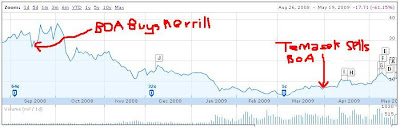
The major news headline to hit the press in July was the failure of the announced leadership transition by Temasek Holdings to materialise. Back in February, Ho Ching announced her resignation and that she would hand over power of Singapore's Sovereign Wealth Fund to Charles Goodyear. At that time, the Merrill-BoA merger was being finalised and the BoA share price was hitting record lows. Here's a snapshot, if you don't remember.

At the time, the announcement was very surprising indeed, to observers who had been used to criticising the fact that Mdm Ho Ching was the Prime Minister's wife, as well as Lee Kuan Yew's daughter-in-law. That the top corporate job in Singapore was held by yet another member of the Lee family was, in the eyes of many observers, evidence of cronyism and nepotism in the Lee regime.

Many speculated over the reason for the sudden announcement of the stepping down of Ho Ching to give way to Charles Goodyear. Perhaps it was because of the massive losses that Temasek had sustained due to its over-allocation of resources to the financial sector. Perhaps it was because Ho Ching couldn't take the criticisms of having ascended to the CEO position because of her connections. Whatever the case, it seemed that Temasek was taking a significant step towards its image as a genuinely independent entity - by putting a foreigner in charge.

Fast forward five months, and Chip goodyear is leaving Temasek before even spending a single day as CEO. He is leaving amicably, due to 'strategic differences' - so goes the official line.

Of course, every Singaporean is left scratching his/her head trying to figure what is going wrong with the Temasek leadership transition. According to sources,
"A person familiar with the situation said last week that Mr. Goodyear's proposals for the company's new strategic direction were considered too risky by some, without elaborating. He also said Mr. Goodyear planned changes in senior management that weren't well received by Temasek's board."
But what are the real reasons? Singaporeans will never know... because Tharman Shanmugaratnam is Ho Ching's best friend.

Aug 18, 2009
S'pore Parliament

No goodwill for Goodyear
By Robin Chan

FORMER chief executive-to-be Mr Charles Goodyear received no goodwill payment for his four months' work at Temasek Holdings the Finance Minister revealed in Parliament.

But after 25 minutes of grilling, the House emerged none the wiser over what exactly the strategic differences were that led to his sudden departure.

Members of Parliament threw question after question at Mr Tharman Shanmugaratnam asking him to get Temasek to share with the public what went on behind the scenes but he would not budge.

He said that disclosing the information would serve no strategic purpose and that was not unlike the actions of other publicly-listed companies in the private sector.

'People do want to know, there is curiosity, it is a matter of public interest. That is not sufficient reason to disclose information. It is not sufficient that there be curiosity and interest that you want to disclose information,' he said in response to questioning from Mr Low Thia Khiang, opposition MP for Hougang.

He reiterated that the words in Temasek's statement to the public were carefully chosen and the Government would not add to that.

But of course. Did any of us really expect Mr Shanmugaratnam to reveal anything that we do not already know? Did any of us really expect to find out anything truly and genuinely useful about Temasek through the parliamentary proceedings?

Of course not - and that's because the Government bears ultimate responsibility for Temasek's stuff ups. Ultimately, the Government must bear the consequences of any mismanagement of reserves. Likewise, it will take credit for any 'good' news where Temasek is concerned. The Government has a vested interested in keeping information about Temasek cock-ups hidden away from public consumption.

Thus, can Temasek ever be expected to suddenly become transparent and candid about its management stuff ups and its investment errors? No, it will only be transparent to the extent that its shareholder demands it, and to the extent that regulations require. Since Temasek is not a publicly listed company, Singaporeans cannot expect Temasek to be transparent on the basis that its publicly listed subsidiaries are. And since Government ministers repeatedly say that it is not their role to comment on individual investments - Temasek will never come clean on individual investment decisions, nor will the truth ever be told about why Chip Goodyear quit.

No - what Singaporeans expect from Temasek - they first have to demand of the Government. If Singaporeans want transparency and accountability about Temasek's investments and policy decisions, they have to first demand transparency and accountability from the Singapore Government. If Singaporeans want information about Temasek's decision making process, they have to demand the same sort of information from the Singapore Government. They have to demand that Tharman Shanmugaratnam keep a close watch on the major individual decisions that Temasek makes - and in turn - either report this information to the Singapore people, or require that Temasek makes the appropriate disclosures. It is only after we establish a culture of tranparency and accountability at the highest echelons of Singapore's society, that the lieutenants & the troops will then follow in line.

Indeed, the Temasek Problem is Not a Temasek Problem; The Temasek Problem is a Government of Singapore problem. Ultimately, the quality of corporate governance of Temasek Holdings will mirror the quality of political governance of the Government of Singapore.

And until Singaporeans realise this, they will have to continue living with the opacity and secrecy that shrouds Temasek Holdings - protected as it is by its political masters.

Friday, May 29, 2009

TOC, Wayangparty have got it wrong here

2 major alternative commentary websites in Singapore's blogosphere, TOC and Wayangparty.com, have come out with their guns blazing and heavily criticising the government's proposed changes to Parliament.

Andrew Loh calls it a "A mockery of Parliament" because of the huge number of "loser MPs", "nominated MPs", and "walkover MPs." He says,

"Parliament being filled with a majority of un-elected members is a joke. Pure and simple, no matter what rhetoric the prime minister uses in trying to convince one and all to accept these changes."

Much as I have been a govt critic in the past, I think the changes announced by Lee Hsien Loong are actually a positive step forward for Singapore as a whole, and that TOC and Wayangparty have got it wrong this time. And much as I think I am going to receive major flak for my comments here, I feel it is necessary to make my case public.

Friday, May 22, 2009

Wiffle Waffle, Gobbledygook, Smokescreens and Nonsense!!!

Warning: This post contains several expletives. Readers who are offended by strong language are advised to proceed cautiously.

Myrna Thomas of Temasek has written to the press to "explain" the BoA divestment. Her press statement not only does not clarify anything, it only insults the intelligence of Singaporeans by repeating the same truisms and smokescreens that Temasek has been saying time and time again.
Why Temasek sold its stake in BoA

I REFER to recent reports and commentaries on Temasek's divestment of its Bank of America (BoA) stake. We would like to clarify some of the points raised.

Temasek invests with the objective of delivering sustainable returns over the long term. This means our investment strategy is not aimed at delivering target returns on a year-by-year basis. This is why we report our portfolio returns not just for a single year, but for various time horizons in our annual Temasek Review.

What the F*cK does this have to do with the BoA issue? You donks have been repeating this nonsense year in year out ad nauseum - it does not give us any information at all, it does not tell us anything - its completely useless statements that achieves nothing!!!

Wednesday, May 20, 2009

This is Becoming Hilarious - and Shameful!!

Forget about Investing for the "Long Term" - Temasek's new investment strategy has changed into "Buy High, Sell Low!!!"


What else could you possibly deduce from the fact that Bank of America's shares have surged 74% since our dear Ho Ching & company decided to divest of their BoA shares? This fact has been graciously pointed out to us by the New York Times - article appended below.


The world is watching our dear Singaporean SWF. And Temasek is becoming the laughing stock of the world financial community.

A commenter on the NYT blog has said:
Regarding Temasek’s decision to sell BofA shares near the low - perhaps sovereign wealth fund managers are really just government bureaucrats masquerading as fund managers? If anyone is going to take a loss on an investment - I’m glad it’s them.

— Posted by Jay Young

Earlier, David Faber of CNBC noted that Temasek's loss was one of the biggest losses ever recorded by a single fund on a single investment in Wall Street's history.


I'm not sure I want to be a Singaporean anymore.

---------------------------------------------------------------------
New York Times - Dealbook

MAY 18, 2009, 11:13 AM
Wall Street Warms Up to Bank of America

Kenneth D. Lewis may have gotten a rebuke from shareholders last month, but he was getting votes of confidence from Wall Street on Monday. Upbeat assessments from analysts at Citigroup and Goldman Sachs lit a fire under shares of Bank of America, the banking giant where he is chief executive — and was chairman until a few weeks ago, when shareholders voted to remove him from that latter post.

At first glance, the enthusiasm might seem to come at a strange time. Banking regulators just told BofA to raise nearly $34 billion, suggesting it was the most anemic of the 19 financial institutions that endured the government’s stress tests.

But some analysts think Bank of America’s efforts to raise the capital are proceeding well. If that overhang clears up, it could ease the pressure that has been weighing on the company’s stock price.

Analysts at Goldman raised BofA from neutral to buy and added the company to their so-called conviction list of recommended stocks. Analysts at Citigroup kept a buy rating on the shares, but had positive things to say about the integration of BofA and Countrywide, the troubled mortgage lender it recently bought, as well as its capital-raising plans.

BofA is using “at-the-market” stock sales to raise a large part of its additional capital cushion. That means the shares are quietly dribbling out in unknown quantities. Reading the tea leaves — and watching the volume of BofA stock trades — analysts at Citi, led by Keith Horowitz, estimate it has already raised $3 billion to $4 billion from selling new stock.

In addition, Bank of America raised an estimate $4 billion after taxes from the recent sale of part of its stake in China Construction Bank.

The biggest unknown appears to lie in BofA’s plan to convert about $16 billion in institutionally held preferred stock into common. If BofA can offer a price that is above the equivalent price of the common shares, it will minimize the dilution for current shareholders, the analysts said.

The analysts’ comments may be gratifying to Mr. Lewis, who endured some heated attacks at last month’s meeting from shareholders who lost money.

But Temasek, the investment arm of Singapore, could be feeling a bit of seller’s remorse. The fund recently reported selling its entire stake in BofA — at an enormous loss, by all accounts — some time before March 31. Since then, BofA’s stock is up about 74 percent.

Monday, May 18, 2009

Dr Lee Boon Yang and Keppel Corp - The Curious Intertwining of Singapore's Business and Politics

Rear Admiral (NS) Lui Tuck Yew was the Minister of State for Education until March 2009, when he was promoted to Acting Minister for Information, Communications and the Arts with effect from 1st April 2009. With his promotion, he displaced the incumbent Dr Lee Boon Yang, who now found himself without a job.

Only 25 days after RAdm Lui's promotion, Dr Lee Boon Yang was the newly appointed non-executive Chairman of Keppel Corp, Singapore's largest industrial conglomerate. It was an event of little fanfare, and by the lack of any noise made by Keppel shareholders, you would have thought that everybody is happy about the change in leadership at the helm of Keppel's board of directors.

However, a careful examination of Dr Lee Boon Yang's CV, and the demands of the role of Chairman of the Board of an industrial conglomerate like Keppel - leaves the interested observer rather puzzled.

Temasek’s divestment of BoA stake – A clear admission of an investment error

"Yes, they were good long term investments with risks thoroughly assessed"

- Minister Tharman, Jan 2008 on Singapore investments in banks.

These were the words of Singapore's Minister of Finance, slightly more than a year ago when Singapore's SWFs made major investments in a few global financial institutions. Take note, in particular, that Minister Tharman was defending the individual investments made by the SWFs in the banks - not the portfolio performance.

A year later, everything had changed. The stock markets had declined significantly and the global financial system was in major turmoil. The stock prices of the big banks had sunk to record lows after having their balance sheets destroyed by the dislocation in credit markets. Seeing that his original argument was no longer tenable, Tharman changed his tack as the investments in the banks sunk deeper and deeper into the red. Now, instead of taking the line that the investments in the banks were good long term investments, he instead argued that Singapore's portfolios were well diversified, and hence Singapore's investments were fine.
'We would be worried if global banks comprise a large proportion of the portfolios of GIC and Temasek, or for that matter, any other highly vulnerable industry globally,' he said. 'But these are diversified portfolios, with not a large degree of concentration risk.'

- Minister Tharman, Jan 2009, on Singapore investments in banks.